

Today I want to discuss the 1-6-6 Rule. Quite simply, this “rule” says that each PowerPoint slide should have one main idea, a maximum of six bullet points, and a maximum of six words per bullet point. Two caveats:
- I have also seen this rule called the 1-5-5 Rule and the 1-7-7 Rule, with necessary changes to the numbers of bullet points and words per bullet point. I have chosen the middle ground.
- The “rule” is not a rule at all. It is nonsense.
Why is it nonsense? Let’s see the 1-6-6 Rule in practice.
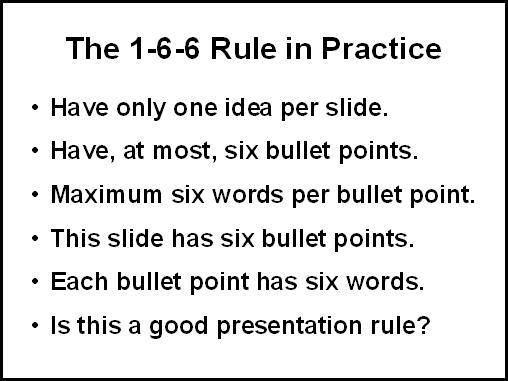
Now, you might think, “I’ve seen worse.” And, at first blush, this slide doesn’t look too bad. The sentences are short and straightforward; the font is large and easy to read. Here’s the problem: It’s only one slide.
Imagine a modest presentation of 16 slides that rigorously follows the 1-6-6 Rule. Looking at the entire presentation in Slide Sorter View will give you some sense of just how bad things could get.
Bombarding your audience with this much text in a presentation is a sure-fire way to stimulate boredom, apathy or revolution. Don’t do it.
I am not opposed to bullet points of text in a presentation. In fact, when used properly, they can be effective. But they should be used sparingly.
Minimize text and avoid long runs of text-only slides. Break things up. Throw in some pictures for visual variety; add a video clip; use a prop; occasionally turn the screen black and – heaven forbid – just speak to the audience.
There are many ways in which to create an engaging presentation so that, when you show important text, your audience will want to read it.
As for the 1-6-6 Rule, please disregard it.















26 Replies to “PowerPoint Math: The 1-6-6 Rule”
Thank you, Thank you, Thank you. Such common sense.
I do wish more people would debunk the crappy PowerPoint “rules” that surround bad presenting. Just reading Presentation Zen again for some insight into what good visual aids should look like.
I concur. PowerPoint is an excellent aid in assisting us deliver the information. Listening to a presenter giving a good presentation without visual aids is what I prefer and remember. I have rarely seen slides
and visuals that I recall when reflecting upon the presentation. Aside from a few clips that were short and to the point, most is completely forgotten. I am a visual learner, needing to see it first to grasp it. So it is interesting for me to note that what I heard and how it was said is what I walk away with.
Jack, much appreciated. I agree with everything that you have said. John
Good post, John.
At first I thought you were endorsing 1-6-6, and I was skeptical. I HATE presentations that are slide after slide of bullets.
As you say, there is the need for the occasional slide with several bullets, but that, IMO, should come after some storytelling supported by slides with big visuals, in which you may need to encapsulate “3 key considerations,” or “the 4 phases of a sale,” or whatever.
I believe so many people use slide after slide, bullet after bullet so that they, as presenters, are prompted to the talking points. I say, if you don’t know your material, then you shouldn’t be presenting. PPT shouldn’t be doing the presenting for you!
Great post!
The question is: why do people stick to their bullets like instant glue to your finger?
I guess, they are afraid of either missing out important points or they just rely on the text because they don’t know their content by heart. They also want to transmit their knowledge and they believe that an image of the rain forest doesn’t transmit the same information as the 5 statistical facts they offer in bullet-point form about wood producion in South America.
To find a compromise I always suggest to use two formats:
In a normal business meeting < 15-20 pax you can distribute handouts with all the "bulleted" information while you present your cool slides.
At a congress you might prepare a (laminated) onepager for the audience which summarizes the content with facts and figures. (which is very well perceived btw)
Fact is once the projector starts to buzz all bullets should escape faster than Frank Morris did from Alcatraz…
Thanks, Florian. Great comments. People take note. John
By the way, when we think of presentation software, Powerpoint has become ubiquitous.
But have you seen/used this new program called “Prezi”?
I’ve just started using it on a project, and it’s SENSATIONAL. It has some limitations, but it’s very much worth checking out. And I’m not a shareholder or representative of it! 🙂
Check it out, really: http://www.prezi.com
Jack
Hey, Jack. Indeed I have seen Prezi. I wrote an article on it some time back. You can read it here: http://wp.me/swfa1-prezi. Thanks for mentioning it, though. Good presentation tools can always use some press. John
Well put. My feelings exactly, John.
Thanks for debunking what really is the Myth of the 1/6/6 Rule.
My view on any slide with just words is “Does this slide really add to my presentation?”
And then I ask, “Would Lincoln have accomplished more at Gettysburg if he’d had some good slides?”
Harry, thanks very much for the comment. And thanks for sharing that link. I like the suggestions that it contains. I particularly like reference to the “ebbing and flowing” of a speech like music. I appreciate your sharing it with us.
John
I think you’ve missed the point of the rule.
The 1-6-6 rule is not that every slide should have 6 lines of text. It’s a guideline to help people to remember to limit the amount of text they dump on slides.
The rule properly expressed is that a PowerPoint slide should have no more than 1 idea, 6 lines of text or 6 words each.
Hi David. Thanks for the comment. Not sure that I have missed the point, though.
As I noted in the first paragraph, the “rule” says that says that each PowerPoint slide should have one main idea, a maximum of six bullet points, and a maximum of six words per bullet point. I agree with you that the rule does not say that each slide should have 6 lines of text. However, by saying that each slide should have no more than six bullet points, the risk is that people will think that if they stay within that limit, they will be OK, even if they adhere to the “rule” slide after slide after slide.
Ultimately we agree on the key point; i.e., not to fill slides up with unnecessary text.
John
Thanks for a useful discussion, John. Hopefully showing how bad this rule can get will put people off using it!
People bring the 1-6-6 rule up quite a lot, and like you say, it suggests slides full of bullets are OK. Sadly, it pushes people towards using bullets to begin with, which to me are one of the poorest uses of a slide!
I’ve noticed that having slide after slide of PICTURES can have a very similar numbing effect to having so many bullets. (An extreme example I saw recently was a webinar where the speaker showed 170+ slides in about 50 minutes. They were nearly all just pictures, with maybe 2 or 3 words here and there. It was extremely disengaging because he tried to cover too much – even though each of his points was small, as though it was a bullet. It really brought home to me that long series of ANY type of slide will put the audience off!)
If speakers shun bullets, often they think they’re doing well and that they’re applying Nancy Duarte’s or Garr Reynolds’ approach. But as you say, it’s far more effective to break things up and vary the delivery mode – rather than just replacing dozens of bullets with dozens of photos!
Lately I’ve come to a new way of thinking about and comparing slide content. So at the end of the post below, I’ve plotted different content types on a chart to show both how informative and how emotive they are (e.g. charts are highly informative and usually less emotive, and photos are typically emotive but less informative). See what you think.
http://remotepossibilities.wordpress.com/2013/04/12/why-present-jfk-said-it-all/
Thanks for the detailed comment, Craig. Very much appreciated and I will have a look at your post. Ultimately, I think a good slide presentation comes down to the right mix of text and pictures and videos. Each has its place, depending on the point being made and the audience.
Cheers!
John
Just wanted to say that readers here might be interested in the pingback below.
It goes to my post called “Quiz: How many words should you put on your slide, and WHY?”
There, you’ll find quotes from Nancy Duarte, Garr Reynolds, Jerry Weissman and other experts backing up my claim that a slide should usually have at most about 15 words on it.
What’s your view on that, John?
Hi Craig,
I don’t adhere to a specific word count limit for slides. Rather, I follow the principle that you should minimize the number of words on any given slide to the extent possible. I have seen experts come out very strongly with a “rule” and then routinely break it. For example, Seth Godin has famously said that you should never have more than six words on a slide. And yet, I have seen several videos on YouTube where he breaks this rule.
I have no problem going over 15 words if it is appropriate and if you don’t do it too often. For example, you might want to put up a famous quote and the picture of the person who said it. Quotes often run more than 15 words. Or, you might have four bullet points with five words each. Throw in a title and that’s 20+ words. But if you bring the bullets in one by one, you don’t overwhelm the audience.
So rather than trying to stick to a specific number, which could result in awkward slides or the rejection of a potentially powerful slide, I think that the best approach is to use the words when necessary but to be sure to use other kinds of slides or even make the screen go black from time to time and just talk to the audience.
Thanks for your very thoughtful reply, John. I’d say my approach is somewhere between yours and Seth’s.
To me it’s useful to have a flexible guideline, rather than a strict rule. Yet, within that, using a specific number (“about 15”) makes the guideline more concrete – and “sexier”. (The longevity of Seth’s 6-word rule shows that numbers count!)
I’m against strict rules because they can’t cope with the range of conditions that presenters face. And as you say, rules often get broken by the people who set them. For instance, I’ve seen Guy Kawasaki state his famous 10-20-30 rule (without caveats, as though it’s universal) and yet smash it himself within his same talk!
So, as I put it in my Quiz post: “If you have… several slides with 20 words each, ask yourself if there’s a better way.”
With quotes (as with slides in general), the wordier they are the less their power. Especially in the age of Twitter, people seek out (and share!) sound-bites much more than spiel.
Naturally, you can always shorten a long quote with an ellipsis or two, to make it punchier. (For instance, in this post about quotes, I show how you might shorten a specific Garr Reynolds quote from 33 words to just 9.)
Still, like you say, there’s little problem with exceeding 15 words some of the time, and I agree that bringing in just a few words at once means people can cope with a bit more text. Also, I strongly support your suggestions of using different slide types, and of blacking the screen.
So in all, there’s much to agree on, and a bit to healthily debate!
I quite like the clarity of the message the 6x6x6 screenshot conveys. We have recently tried to make a similar point by asking ourselves what one can learn from Twitter.
Thanks for the comment, Achim. And a nice post with the comparison to Twitter.
More like six words per sentence, six bullet points per slide, each having one sentence, that is to say, six sentence per slide. Might as well throw in an inverted pentagram.
I could not help but comment, “only a Seth deals in absolutes.”
6 words per bullet point
6 bullet points per slide
6 lines of text per slide.
One inverted pentagram.
Ha! Indeed.
John: I would like to see some general rule about how many “spoken” words are ideal per slide (regardless of what is on the presented slide). In other words, what is a general guideline for how much content you should put into the notes for each slide?
It’s an interesting question, Gregory, but I don’t believe there is a hard and fast rule. It depends on the slide and the subject. For example, I sometimes tell a story about Demosthenes and how he became a great orator. I have a slide with an image of Demosthenes walking by the sea and one word: “Demosthenes”. But the story / message can easily go for two or three minutes. I have other slides with more words on them but fewer spoken words.
And, by the way, I never use the notes function on PowerPoint or Keynote. I don’t want to be looking at my computer screen. In my opinion, the information on the slide should be enough to prompt the speaker.
Your selection of topic is very good and also well written.. Thanks for sharing.
Thank you, Manish.