
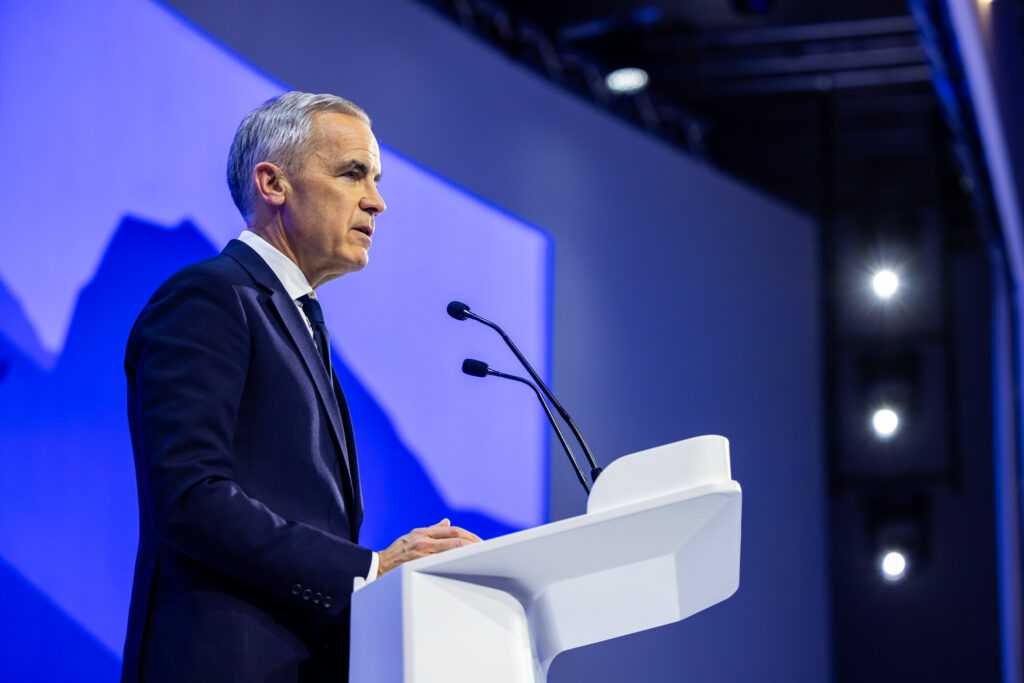
At the World Economic Forum meeting in Davos, the world has grown accustomed to speeches that are loud, polished, and quickly forgotten.
This one was different.
On 20 January 2026, Canadian Prime Minister Mark Carney delivered a speech that has garnered international attention and praise. It was a speech that came at a fraught time for the world.
The unpredictable wrecking ball that is Donald Trump’s administration is creating havoc around the world politically, economically, and socially. As a country that shares a 9,000-km border with the US, Canada is in a unique—and uniquely vulnerable—position. Being a proud Canadian, I feel it personally.
Yet in the face of these challenges, Carney did not try to dominate the room. He did not rely on slogans or bravado. Instead, he did something far more difficult: he named the reality, calmly and without illusion, and proposed a way forward.
This was not a speech about incremental change. It was a speech about rupture—moral, economic and geopolitical. And crucially, it was a speech that used language with precision and restraint to signal a break between an old world that no longer works and a future that has yet to be built.
In this post, I share my analysis of Carney’s speech: what worked well and what might have been improved. I focus on how he uses language, structure, and rhetorical choices to frame reality, build credibility, and persuade. And I explain why these choices matter for anyone who speaks about complex, high-stakes issues.
Watch the speech
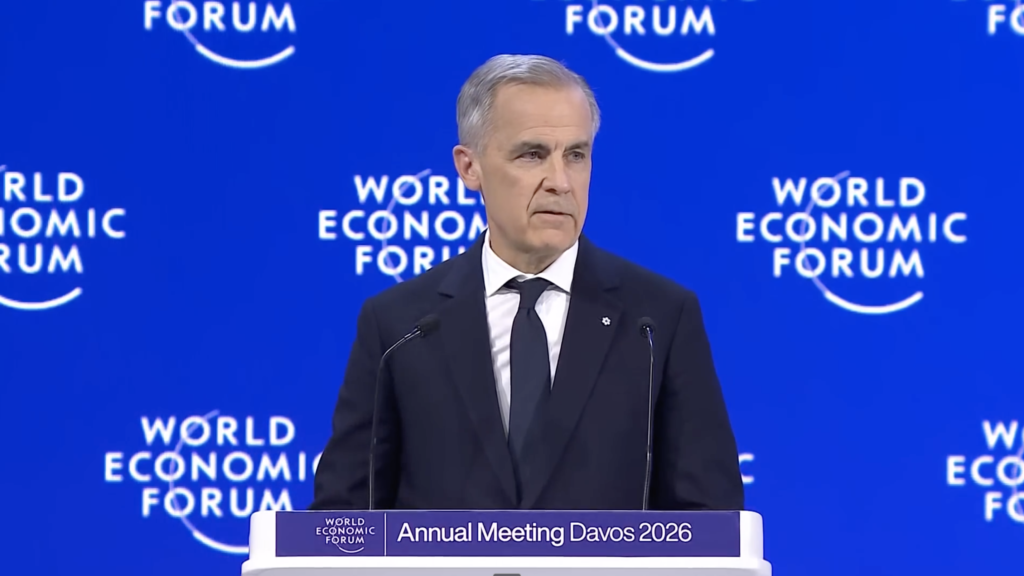
A courageous speech, delivered with class
This was a courageous speech. Without naming him directly, it was clear that Carney took direct aim at Trump and his policies. He didn’t use hyperbole, and he didn’t use insults or ad hominem attacks. He simply laid out, step by step, why the old rules-based international system no longer works and what countries must do in response.
Some have said that the speech was less a courageous one and more one given out of the necessity to finally stand up to Trump. I don’t share this view.
It is clear from Trump’s speech at Davos the very next day that Carney’s speech had irked him. Given Trump’s tendency to be erratic and his taste for vengeance, it is impossible to know how he might respond. Indeed, just a few days after Carney’s speech, Trump posted this message on social media: “If Canada makes a deal with China, it will immediately be hit with a 100% Tariff against all Canadian goods and products coming into the U.S.A.”
So we now have the President of the United States threatening Canada—its greatest ally—for trying to find markets for its goods. It’s absurd. And with the Canada-US-Mexico free trade agreement due to be renegotiated this year, who knows what will happen. There is so much at stake.
Carney deserves credit for calling out the elephant in the room and for doing so in a dignified manner; a manner befitting the leader of a country. It is high time that the world stood up to Trump and stopped trying to appease him. Anyone with a cursory knowledge of the events of the last 90 years will know that appeasement does not work. It only emboldens those who are more powerful.
At 14:04, Carney says that we have to name reality. We have to call the current international order what it is: “a system of intensifying great power rivalry where the most powerful pursue their interests using economic integration as coercion.”
And at the end of the speech (16:45), he says, “The powerful have their power. But we have something too: the capacity to stop pretending, to name realities, to build our strength at home and to act together.”
Canada finds itself a David facing a dangerous Goliath. Carney’s speech was nothing if not courageous.
Connecting with the audience
Speakers who can demonstrate that they share something in common with the audience—values, experiences, hopes, dreams, concerns—have the ability to connect on a deeper level.
Business leaders often react to politicians’ speeches with emotion that ranges from skepticism to contempt. Indeed, at Davos, business leaders expressed significant suspicion and frustration toward politicians because of concerns over erratic policy, geopolitical instability, and a perceived retreat from a rules-based global order.
So, as a politician, Carney faced this challenge. However, he had a few things going in his favour.
First, he came to the stage already in possession of solid credentials to connect with a Davos audience. Not only is he the Prime Minister of Canada, but he has a track record that includes: 13 years at Goldman Sachs, 5 years as the Governor of the Bank of Canada, and 7 years as the Governor of the Bank of England.
Carney already had ethos when he stepped onto the stage. But he went further. He used a specific moment in his speech to connect with the audience on a practical level.
At 07:03, he addresses the room’s experience directly: “This room knows this is classic risk management. Risk management comes at a price, but that cost of strategic autonomy, of sovereignty, can also be shared. Collective investments in resilience are cheaper than everyone building their own fortresses. Shared standards reduce fragmentations. Complementarities are positive sum.”
The people in the audience have almost certainly had experience with risk management so Carney is meeting them on familiar ground with his words.
Whenever you can show the audience that you share something in common with them, it is always a net positive.
A powerful extended metaphor
At 01:50, Carney warns against the tendency for countries to accommodate and avoid trouble in order to buy safety, because it won’t. And so, he asks, “What are our options?”
His answer begins with reference to a 1978 essay by the then Czech dissident Václav Havel entitled, “The Power of the Powerless.” In it, Havel wrote about how under the communist system, a greengrocer would place a sign in his store window supporting the regime. He didn’t believe it; nobody believed it. But everyone put a sign up to avoid trouble and to signal compliance.
The power of the communist system came not from its truth, but from everyone’s willingness to behave as if it were true. And that was also the source of its fragility. Because when even one person stopped performing—when the greengrocer and other merchants removed their signs—the illusion would begin to crack.
Carney uses Havel’s story and the metaphor of the sign throughout his speech to persuade others to stop pretending that the old international order still works.
03:27 – “Friends, it is time for companies and countries to take their signs down.”
04:36 – “So we placed the sign in the window. We participated in the rituals, and we largely avoided calling out the gaps between rhetoric and reality.”
13:47 – “Which brings me back to Havel. What does it mean for middle powers to live the truth?
14:20 – “When middle powers criticize economic intimidation from one direction but stay silent when it comes from another, we are keeping the sign in the window.”
16:15 – “We [Canada] are taking the sign out of the window. We know the old order is not coming back.”
People around the world are talking about taking the sign out of the window and it is something that will stick for a long time.
Having said that, there has been some criticism that the metaphor, as used by Carney, does not work. My good friend Antti Mustakallio—an expert speech writer and the founder of the Retoriikan kesäkoulu (Summer School of Rhetoric in Finland)—has written a thoughtful analysis of Carney’s speech which I encourage you to read here.
Antti rightly argues that whereas the communist system in Europe “was a repressive regime that systematically violated human rights, one in which people participated out of fear and, ultimately, under the threat of violence,” the rules-based international order was not that. Indeed, Carney admits, at 03:43, that Canada prospered under that system for decades.
Thus, Antti concludes that Carney committed an error because the metaphor “… equates a voluntary, agreement-based international order with a coercive system built on fear and violence. Used this way, the analogy suggests that commitment to the rules-based order was, in itself, an unethical performance rather than an attempt to restrain power.”
I have given this point a lot of thought, both because of my respect for Antti and because I want to be sure that my favourable impression of the metaphor is not skewed by me being a Canadian who, like most of my fellow Canadians, is deeply offended by the way in which Trump and his administration have acted toward us.
In the end, I believe that the metaphor works. It works because Carney isn’t comparing the post-WWII order to Soviet communism. He’s comparing the current moment—where middle powers feel compelled to perform deference to avoid retaliation—to Havel’s insight about complicity. The sign in the window isn’t about the old rules-based order; it’s about the pretence that it still exists. This conclusion is reinforced at several points in the speech.
At 04:24, Carney acknowledges the good that American hegemony has done in the past: public goods, open sea lanes, a stable financial system, collective security and support for frameworks for resolving disputes. But 25 seconds later (04:49), he says that “this bargain no longer works.” (Emphasis added.)
Then, just 18 seconds further (05:07), Carney says, “But more recently, great powers have begun using economic integration as weapons, tariffs as leverage, financial infrastructure as coercion, supply chains as vulnerabilities to be exploited. You cannot live within the lie of mutual benefit through integration when integration becomes the source of your subordination.” (Emphasis added.)
At 07:45, Carney says that Canada was amongst the first to hear the “wake-up call.” I think this is a clear reference to Trump’s imposition of tariffs on Canada and his constant statements about Canada becoming the 51st state. (Not going to happen.)
At 10:38, Carney says that Canada stands firmly with Greenland and Denmark and fully supports their unique right to determine Greenland’s future. At 11:22, he states Canada’s strong opposition to tariffs over Greenland. It is clear that he is talking about the current situation created by Trump.
Even Antti concedes in his post that the metaphor could be charitably viewed the way in which I have described it above.
Where I do agree with Antti is that Carney could have made the metaphor more powerful with just a little more precision. For example, at 04:36, when Carney speaks of putting the sign in the window, he could have said that we placed the sign in the window because we believed in the system as it used to exist. Although not perfect, it was a system that worked and that provided security and prosperity. Carney could then have said that the system is no longer working, and that it is now time to take the sign down.
Metaphors can make abstract ideas concrete and vivid, helping audiences grasp complex concepts instantly. They engage emotions, spark imagination and are memorable, turning analysis into storytelling that moves listeners to action. If you use a metaphor, just make sure that it is clear and precise.
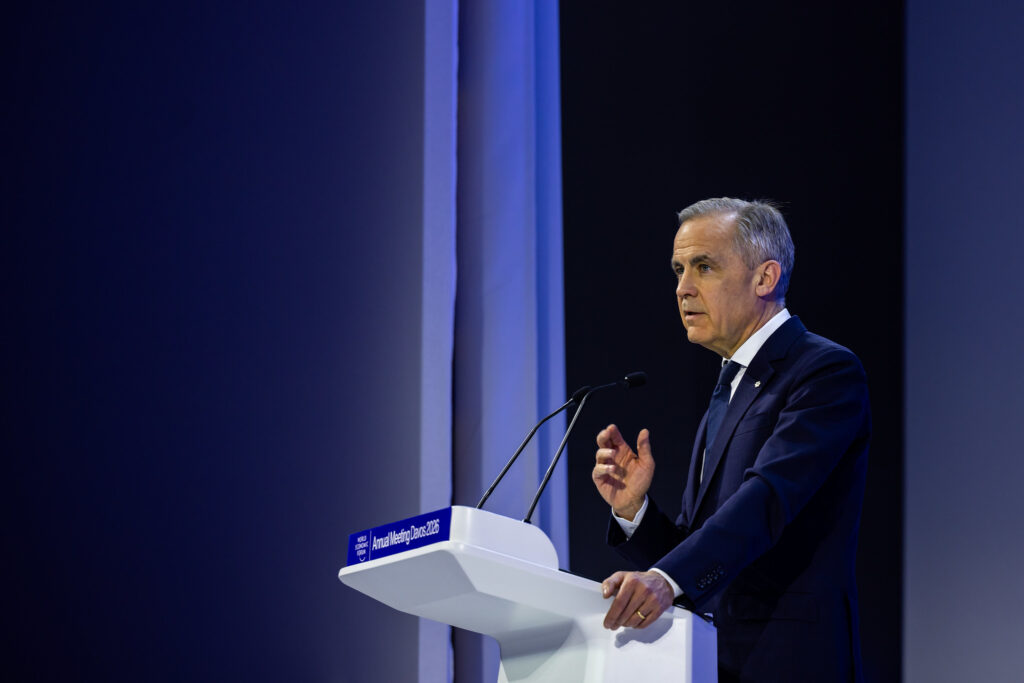
Rhetorical devices
Rhetoric is the art of using language to communicate effectively and persuade. Aristotle wrote the classic book on the subject, On Rhetoric, in the 4th century BC. For centuries, the study of rhetoric—the ability to speak in public and to move audiences with logic, emotion and credibility—was an important component of many educational systems.
In his speech, Carney uses several rhetorical devices to great effect. In addition to the extended metaphor discussed above, below are four others.
Antithesis
Antithesis is the contrasting of two opposing ideas in a grammatically balanced or parallel structure. It clarifies complex thoughts by sharpening the contrast, making arguments more memorable and persuasive. Think Charles Dickens: “It was the best of times, it was the worst of times.”
As Aristotle noted in his Rhetoric, this opposition aids understanding and retention by highlighting differences starkly, engaging the audience intellectually and emotionally.
Carney’s speech is a masterclass in the use of antithesis. It is by far the most important rhetorical device. He uses it to set out in stark terms the contrast between the way the international order was and the way it is now. And he uses it over and over again. Not just for show, but for impact (which is also an antithesis).
00:30 – (In French) “Today I will talk about the breakdown of the world order, the end of a pleasant fiction, and the beginning of a brutal reality …”
01:35 – “It seems that every day we’re reminded … that the strong can do what they can, and the weak must suffer what they must.”
04:55 – “We are in the midst of a rupture, not a transition.”
05:20 – “You cannot live within the lie of mutual benefit through integration when integration becomes the source of your subordination.”
06:07 – “When the rules no longer protect you, you must protect yourself.”
07:00 – “They’ll buy insurance, increase options in order to rebuild sovereignty—sovereignty that was once grounded in rules but will increasingly be anchored in the ability to withstand pressure.”
08:46 – “We actively take on the world as it is, not wait around for a world we wish to be.”
12:42 – “Our view is the middle powers must act together because if we’re not at the table, we’re on the menu.” (Also a powerful metaphor.)
13:13 – “This is not sovereignty. It’s the performance of sovereignty while accepting subordination.” (The second clause adds a layer of irony or paradox, underscoring how the act of pretending to be sovereign actually reinforces dependency.)
13:22 – “In a world of great power rivalry, the countries in between have a choice: compete with each other for favour, or combine to create a third path with impact.”
14:52 – “And diversification internationally is not just economic prudence; it’s a material foundation for honest foreign policy…”
16:08 – “We understand that this rupture calls for more than adaptation. It calls for honesty about the world as it is.”
Asyndeton
Asyndeton is the omission of conjunctions such as “and”, “or”, “for” and “but” from a series of related phrases or clauses. It adds speed and rhythm to the words, and it leaves an impression that the list is not complete. This creates emphasis and emotional intensity, leaving the audience with a sense of incompleteness that draws them in.
It is not the most common of rhetorical devices, but Carney uses it well a few times.
01:50 – “… there is a strong tendency for countries to go along to get along, to accommodate, to avoid trouble, to hope that compliance will buy safety.”
05:10 – “But more recently, great powers have begun using economic integration as weapons, tariffs as leverage, financial infrastructure as coercion, supply chains as vulnerabilities to be exploited.”
16:25 – “Nostalgia is not a strategy, but we believe that from the fracture we can build something bigger, better, stronger, more just.”
Chiasmus
Chiasmus is a rhetorical device where words, phrases, or grammatical structures in one clause are repeated in reverse order in the next clause. It forms an A-B-B-A or “criss-cross” pattern (named after the Greek letter chi (Χ, χ)).
Chiasmus creates symmetry and rhythm, making phrases instantly memorable and persuasive. It reinforces ideas through inversion, simplifies complex contrasts, and gives arguments a sense of completeness, engaging listeners emotionally and intellectually.
In the middle of Carney’s speech, he uses a powerful chiasmus about which I have written more in a previous post.
09:10 – “And we are no longer just relying on the strength of our values, but also the value of our strength.”
Tricolon
Tricolon is a rhetorical device using three parallel words, phrases, or clauses of increasing length or power, often for rhythmic emphasis. The rule of three taps into how our brains process information, boosting memorability and emotional punch in speeches.
Carney uses several tricolons in his speech, some of which are also asyndetons.
02:45 – “But he places the sign anyway to avoid trouble, to signal compliance, to get along.”
03:50 – “We joined its institutions, we praised its principles, we benefited from its predictability.”
06:00 – “A country that cannot feed itself, fuel itself or defend itself has few options.”
06:15 – “A world of fortresses will be poorer, more fragile and less sustainable.”
08:44 – “So we’re engaging broadly, strategically, with open eyes.”
15:40 – “Canada is a pluralistic society that works. Our public square is loud, diverse and free.”
A call to action
Every speech should have an objective. What do you want the audience to do after you have finished speaking? If you don’t want them to do anything, you could save everyone a lot of time and just send an email. The most powerful speeches are the ones that have a call to action; that move the audience to something.
Carney begins his call to action at 13:50 by asking what all of this means for middle powers. He then gives his answer which, by my count, encompasses six things:
- Name reality and admit what is going on
- Act consistently and apply the same standards to allies and rivals
- Create institutions and agreements that function as described
- Reduce the leverage that enables coercion
- Build strong domestic economies
- Diversify internationally
One might argue that six things is a lot for an audience to absorb. Fair enough, but given the complexity of what is transpiring in international relations these days, I have no problem giving Carney a pass. There are many variables at play and there is no one thing that will address them.
Furthermore, by this point in the speech, Carney has established his credibility to make this call to action. At 09:20 of the speech, Carney sets out all of the things that his government has been doing and which address most of his call to action above. This includes:
- $1 trillion of investments in energy, AI, critical minerals, new trade corridors
- Doubling defence spending
- Establishing a strategic partnership with the EU
- Signing 12 other trade and security deals on four continents in six months
- Establishing strategic partnerships with China and Qatar
- Negotiating free trade pacts with India, ASEAN, Thailand, Philippines and Mercosur
When you are preparing for your next speech or presentation, spend some time thinking deeply about what you want your audience to do and why. And although Carney (appropriately) proposes six things for his audience to do, I recommend that you keep the call to action as simple as possible. Ideally, one thing.
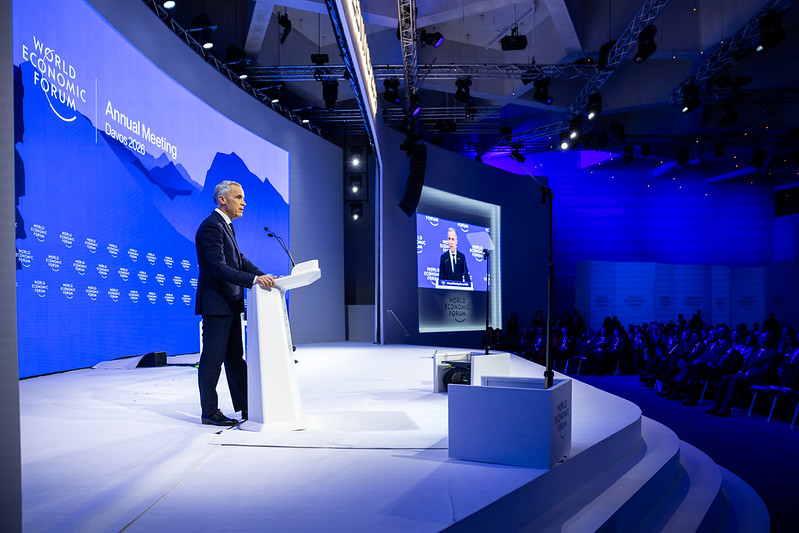
What could have been improved
No speech, no matter how good, is perfect. There is always room for improvement, and Carney’s speech is no exception. Here are a few thoughts.
Poor opening words
Carney’s first words are procedural housekeeping: “Thank you very much, Larry. I’m going to start in French, and then I’ll switch back to English.”
If you want to begin by publicly thanking the person who introduced you, fine. It’s not the end of the world. What I typically do is thank the person, on stage, by shaking their hand and saying a few private words to them in front of the audience so that it is clear that I am thanking them.
But the second sentence should have been dropped. Instead, Carney should have asked the person who introduced him to tell the audience that the speech would begin in French and then switch to English.
You get one chance to make a good first impression, so make your first words count.
The extended metaphor of the greengrocer and the sign
I have discussed how the metaphor could have been tighter above.
Some convoluted language
There were moments when Carney’s language drifted into vague jargon.
For example, at 08:04: “We are calibrating our relationships so their depth reflects our values, and we’re prioritizing broad engagement to maximize our influence, given the fluidity of the world at the moment, the risks that this poses and the stakes for what comes next.”
At 41 words, it is a long sentence. The key insight—relationships based on values and pragmatic engagement—is buried under abstract process language: calibrating, prioritizing and maximizing. It is nothing like the simple, powerful language that Carney uses elsewhere in the speech.
Simplicity is the ultimate sophistication. Carney could have chosen simpler language. For example, he might have said something like: “We will deepen our relationships with countries that share our values. But we also have to be pragmatic. So, we will also work, where possible, with countries other than our closest allies.”
Alternatively, Carney could have kept the complex language and then explain it. In fact, he does this very thing a bit later in the speech.
At 10:20, he says “We’re doing something else: to help solve global problems, we’re pursuing variable geometry.”
I had to look up the definition of “variable geometry”. (It is a design principle where components of a system, like as aircraft wings, adjust their shape or configuration in real-time to optimize performance under changing conditions.) In the context of Carney’s speech, it is very abstract. But Carney immediately explains what he means and gives a concrete example:
10:23 – “In other words, different coalitions for different issues based on common values and interests. So, on Ukraine, we’re a core member of the Coalition of the Willing and one of the largest per capita contributors to its defence and security.”
Never forget that we all suffer from the curse of knowledge. Just because you know what you are saying, it does not guarantee that the audience will understand. If you have to choose between clarity and eloquence, choose clarity every time.
An mistimed smile
The metaphor “… if we’re not at the table, we’re on the menu” was brilliant. If you listen around 12:45, you will hear some people laughing. Carney pauses for a moment and smiles. I know it is hard not to smile when you get a laugh from the audience—the reaction is, understandably, often automatic and hard to control—but I wish that Carney had kept his serious demeanor.
If the metaphor is powerful, it is because it is accurate. Nobody wants to be “on the menu.” It would have been more powerful for Carney to maintain a serious look so that there was coherence between what he said, how he said it, and the way he looked while saying it.
One way in which Carney could have pre-empted the laugh would have been to deliver the line more forcefully and with even more gravitas. It’s an example of how the quality of your voice—volume, tone, pace, pauses—can affect the audience.
Carney’s smile certainly wasn’t fatal to his speech. But it’s a useful reminder that when you deliver powerful lines in your speeches and presentations, you want to make sure that you deliver them the right way. The words, tone and facial expressions should be congruent.
Conclusion
Mark Carney’s Davos speech is a rhetorical triumph that could mark a turning point in middle-power diplomacy. It calls out the rupture in the global order, using the extended metaphor of the greengrocer and the sign to expose performative illusions of sovereignty and mutual benefit.
Carney blends realism with moral clarity (“… we aim to be both principled and pragmatic”). His repeated use of antithesis drives home contrasts and builds urgency. The speech is structurally tight and calls middle powers to strategic autonomy and genuine coalitions without nostalgia or naivety.
Carney’s speech is worthy of study and I encourage you to spend some time with it. There is lots to learn.
And then, go take down whatever “signs” no longer belong in your window. Don’t let someone else tell you what to display.